A descriptive geometry construction, drawn out step by step
Given a photo of an engineering-drawing exercise — construct a line that crosses two given lines while staying parallel to a third — Xiaohe worked out the construction, redrew the projection figure from a coordinate table, and produced a 6:50 narrated video in which each auxiliary line is drawn from its starting point to its end.
Watch the construction being drawn
6:50 · 1920×1080 · 13 slides
From the plate to the drawing
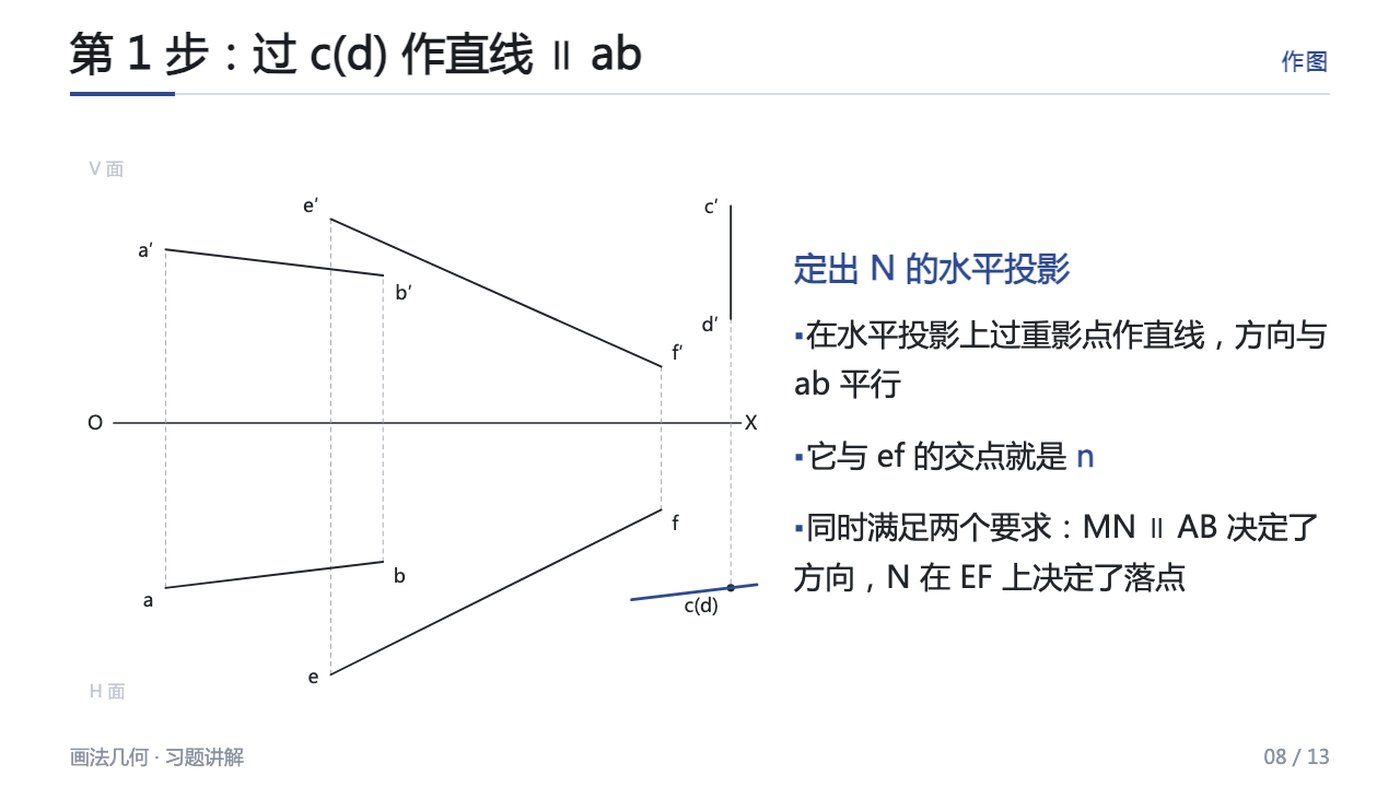
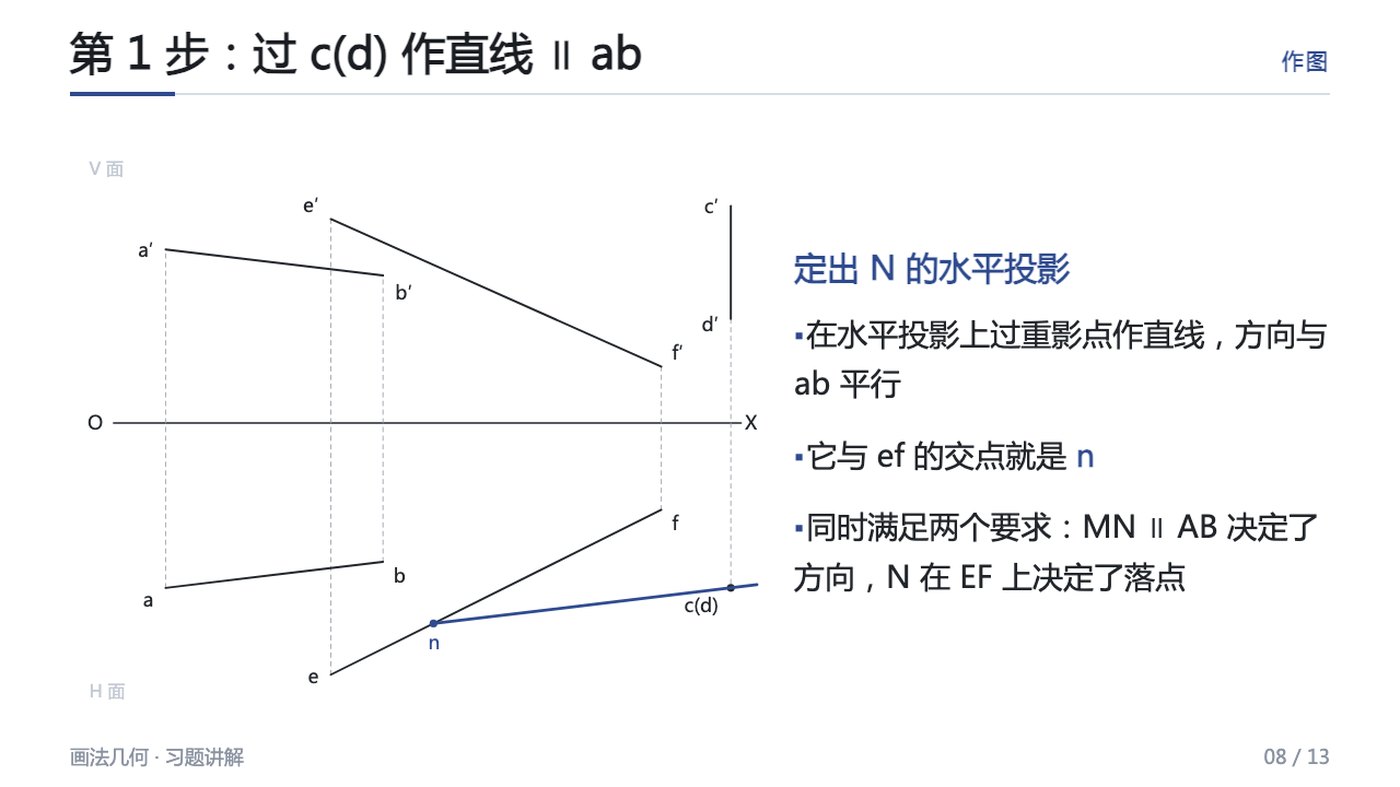
The task
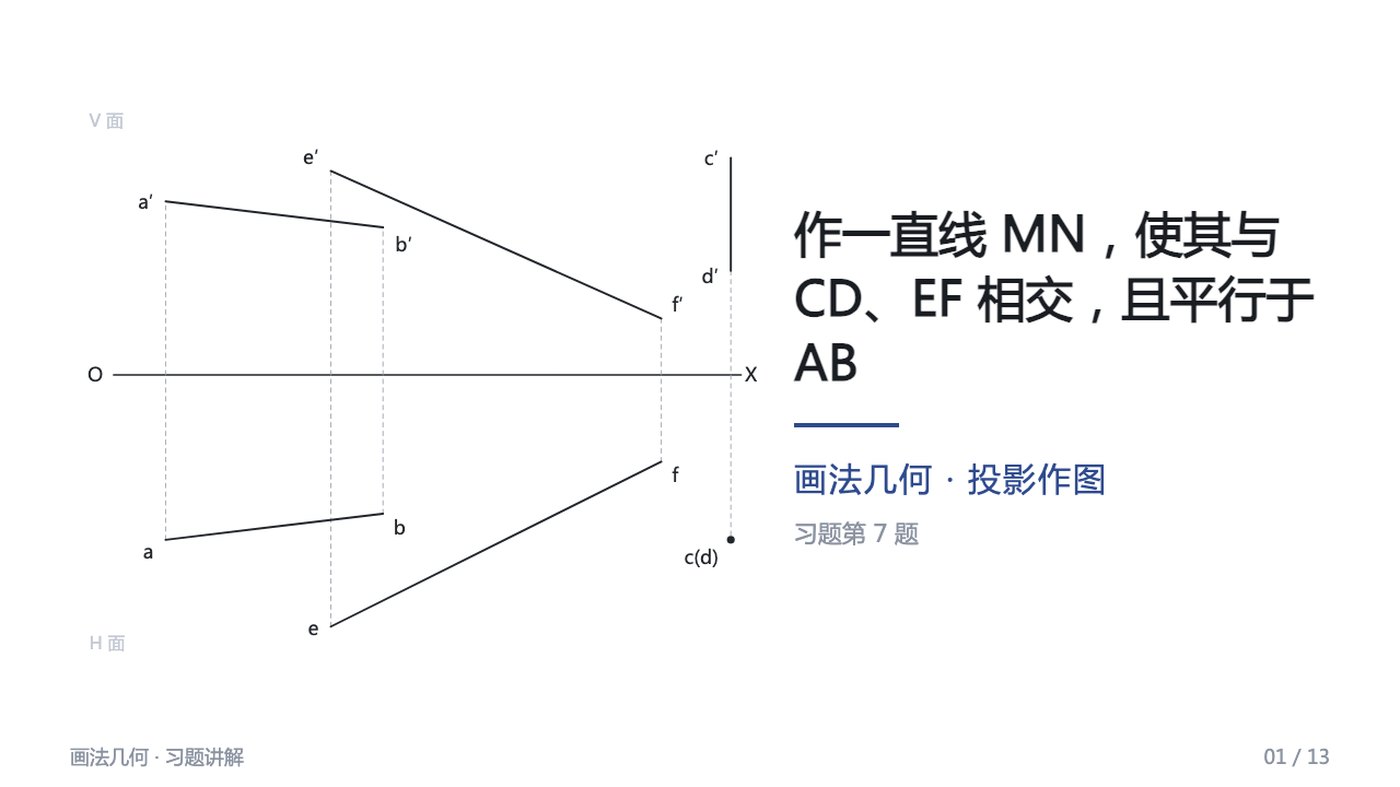
A parent handed Xiaohe a phone photo of a descriptive-geometry exercise: construct a line MN that meets two given lines CD and EF, and is at the same time parallel to a third line AB. Earlier lectures in this series were for an elementary student. This one is a university engineering-drawing problem, and that changes what the video has to be.
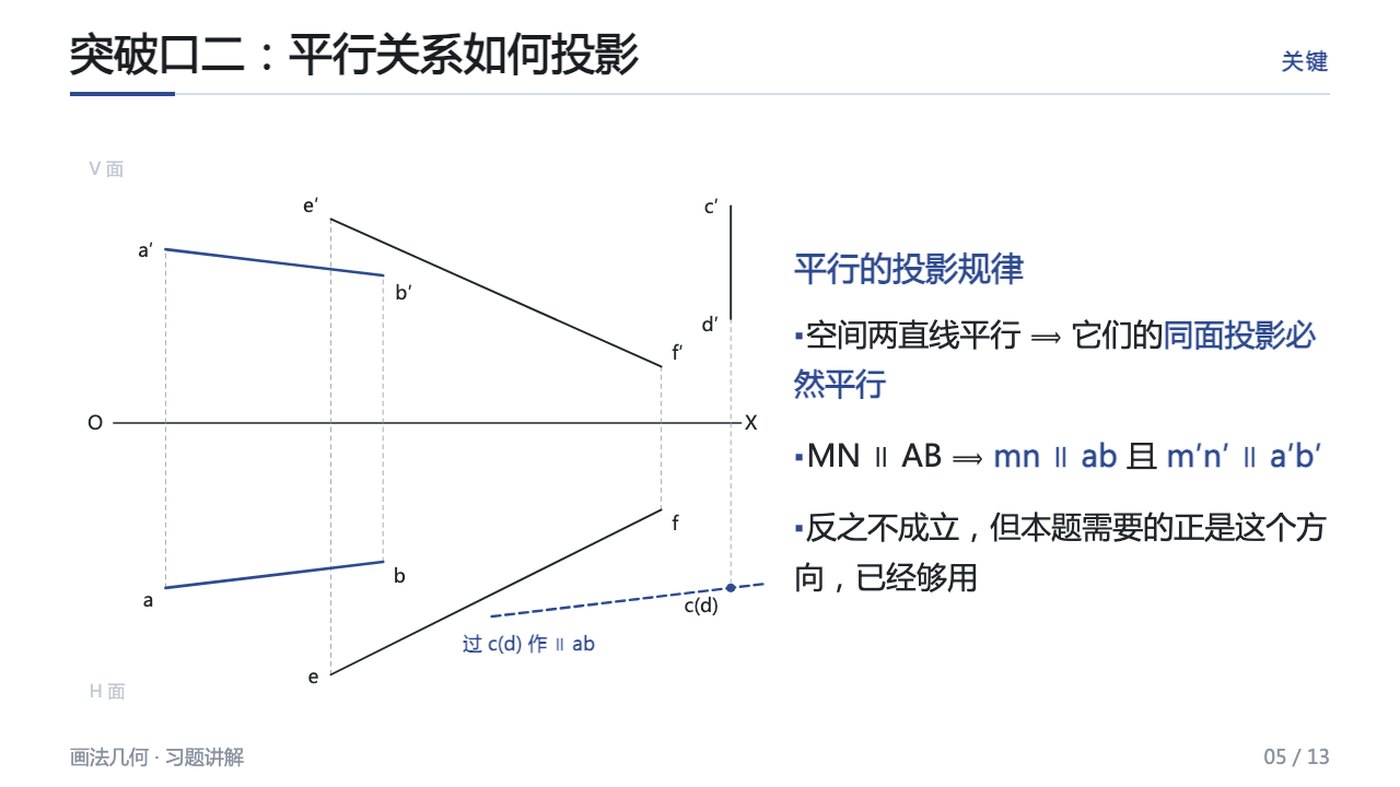
The first real work was reading the plate. The student had already drawn all over it, so the printed givens and the pencil construction had to be pulled apart — only the givens may be redrawn, otherwise someone else’s answer gets presented as the problem. That reading also produced the key: in the horizontal view, C and D land on the same point. Two points that coincide mean every point on CD shares one horizontal projection, so CD is perpendicular to the horizontal plane — and that single fact pins the point M down before any construction begins. The rest of the solution follows from it.
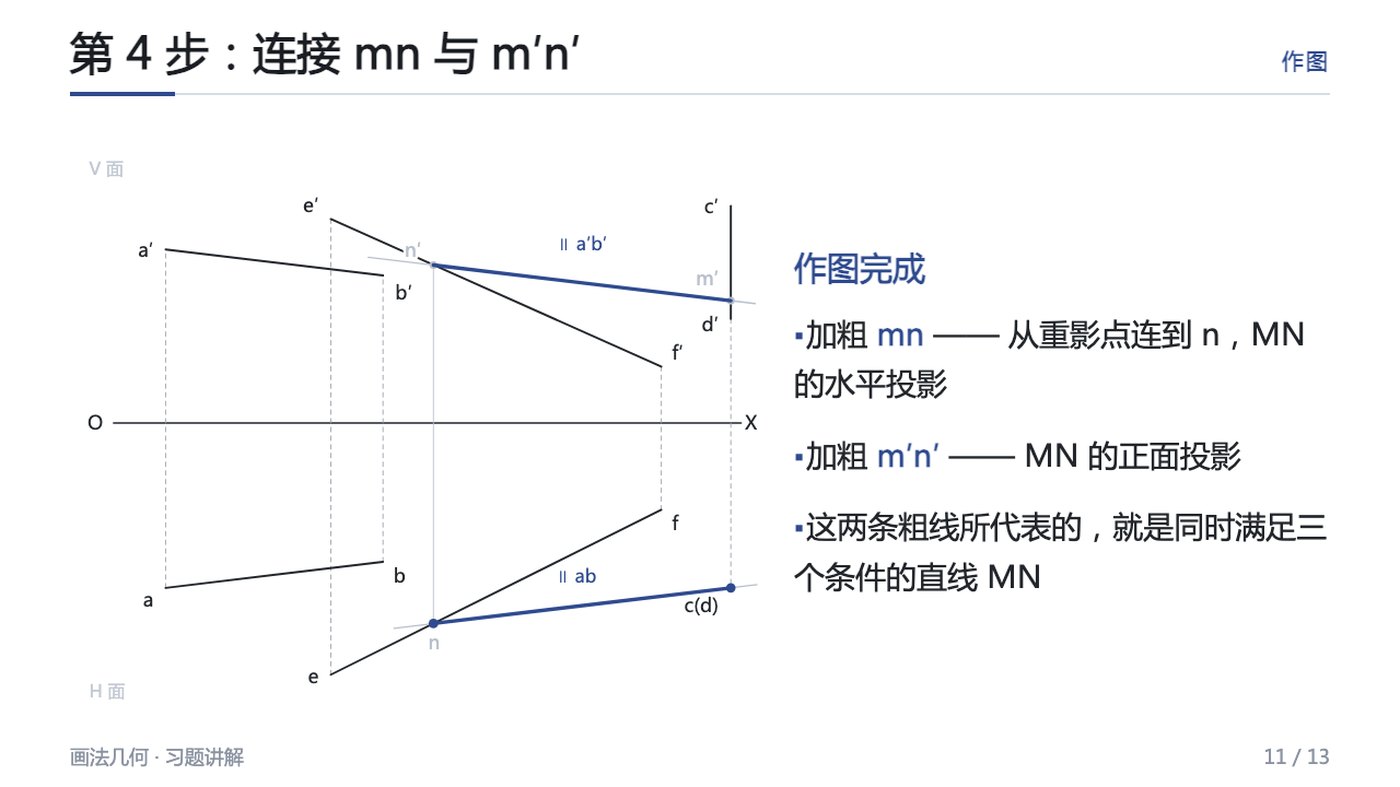
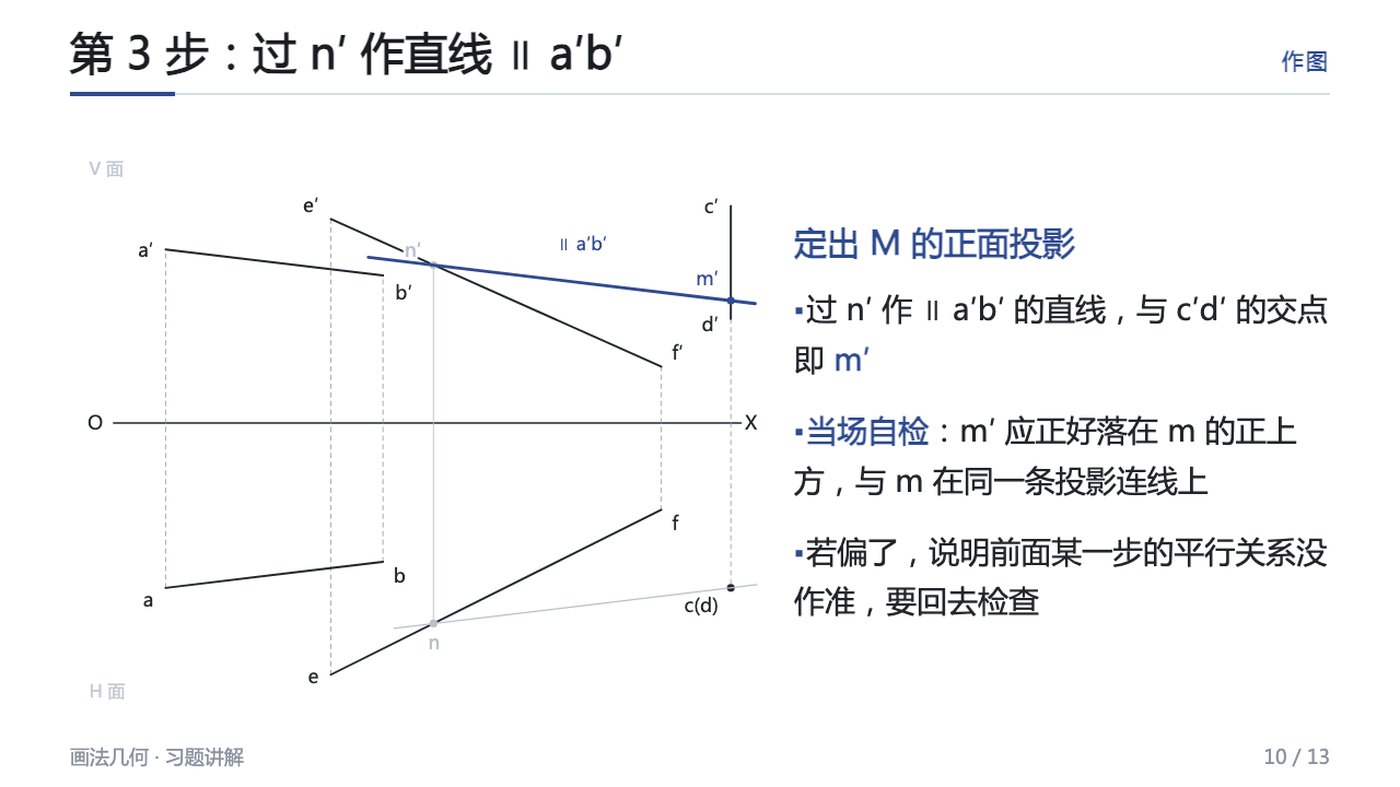
We then rebuilt the figure from a coordinate table rather than tracing the photo, because the lines have to be exact: a construction that looks approximately parallel teaches the wrong thing. That made one more thing possible. A construction is a sequence, so the video draws each new auxiliary line from its starting point to its end, and the labels and dots appear only once the pen reaches them — the viewer sees the step happen rather than being handed a finished diagram. That is the part an elementary-school lecture never needed. As with the other works here, this runs on top of an existing agent harness and a TTS service; what we build is the layer that turns a task like this into something a person can watch and follow.
How Xiaohe did it
1. Read the plate
Straighten the phone photo, then separate the printed givens from the student’s pencil work. Only the givens get redrawn.
2. Solve
C and D share a horizontal projection, so CD is perpendicular to the horizontal plane and M is already located. The construction becomes: draw through c(d) a line parallel to ab, meet ef at n, project n up to n′, then draw through n′ the parallel to a′b′ to meet c′d′ at m′.
3. Rebuild the figure from coordinates
A script emits every page as SVG from one coordinate table, so all slides share a single coordinate system and the drawing never jumps between pages.
4. Slide layout
Drawing on the left, words on the right, on the same slide — split across two slides, neither half stands on its own. The cover is the problem card, so the figure is on screen from the first spoken word.
5. Narrate
The script is written for the ear, so no symbols survive into the text. Spatial lines and their projections share a name, so every projection is spoken with its qualifier — “horizontal projection m n”, never bare “m n”.
6. Animate the drawing
Each step renders 19 partially-drawn frames. The animation is carved out of that page’s own narration time, so the total length still equals the audio and nothing drifts out of sync.
7. Check and deliver
Check the audio by transcribing it back to text — what the transcript cannot tell apart, a listener cannot either. Then eyeball the figures at near-final size, ship the video, the deck and the figure sources.
Skills used
- lecture-agent
- ppt-agent · HTML → SVG → PPTX
- Doubao TTS
- Coordinate-driven SVG (written for this work)
Deliverables
More works
Real tasks, from the terminal to a finished document.